
This post offers a great rundown of clearing a sample and everything that comes with it. Written by Karl Fowlkes, an Entertainment Attorney, Music Industry and Hip Hop Professor, we’d like to share this info in the hopes of helping artists, producers, managers, and labels understand what it actually takes to use a sample the right way. Thanks, Karl. Let’s dive in.
How to Clear a Sample: A Step-by-Step Guide for Artists
Hip Hop and samples go hand in hand, for better or for worse. We’ve seen samples become the core element in some of the greatest records ever. We have also seen samples hinder the release of a record because the copyright owners refuse to offer clearance. That’s the paradox when deciding to use a sample.
Sample clearance is the process of getting permission to use part of an existing recording or composition in a new song. In most cases, that means clearing two separate rights: the master recording and the underlying composition. If you skip this step, your release can face takedowns, frozen royalties, delayed distribution, or legal issues after the song is already out.
Key Takeaways
Clearing a sample usually means getting permission for two rights: the master recording and the underlying composition.
Artists should clear samples before release, not after a song gains traction.
Sample clearance can involve upfront fees, royalty shares, and publishing splits, so the sample needs to be worth the long-term tradeoff.
Interpolation is different from sampling because it recreates part of a song instead of using the original recording.
How to Clear a Sample Step by Step
Before getting into whether a sample is worth it, it helps to understand the actual clearance process. Every song is different, but most sample clearances follow the same general path.
1. Identify exactly what you sampled
Start by documenting the original song title, artist, writers, producers, label, publisher information, and the exact part of the recording you used. Note the timestamp, length of the sample, and how it appears in your new song. The more specific you are, the easier it is to explain the request to rights holders.
2. Figure out who owns the master recording
The master recording is the actual recorded version of the song. This is often controlled by a label, but it can also be controlled by the artist, a catalog company, or another rights owner. You will typically need a master use license to use the original recording in your new track.
3. Figure out who controls the composition
The composition is the underlying melody, lyrics, beat, and musical work. This side may involve multiple songwriters, publishers, administrators, or estates. To clear the publishing side, you need approval from the parties that control the composition.
4. Contact the rights holders before release
Once you know who controls the master and the composition, reach out with a clear request. Include your artist name, song title, the original work being sampled, how much of the sample is used, where it appears, whether the song has already been released, and what type of release you are planning.
5. Negotiate the fee, royalties, and publishing split
Sample clearance terms can vary a lot. The rights holders may ask for an upfront fee, a royalty on the new master, a share of publishing, credit, or a combination of these. These terms are negotiable, but the more important the sample is to the new song, the more leverage the original rights holders may have.
6. Get everything in writing
Do not rely on a verbal yes, a DM, or an email thread as your final clearance. Make sure the agreement clearly states what is being cleared, who approved it, what the payment terms are, what royalty or publishing split applies, and where the song can be used.
The Art of Clearing A Sample: Deciding If It’s Worth It and How To Actually Do It
It’s a cost/benefit analysis every time.
Is the upfront fee and publishing/royalties you’re giving up worth using the sample? If you are a producer using a sample on an instrumental, it’s also likely to affect your payout and publishing split. Regardless, always be transparent to the artists and labels involved if you have used a sample, as litigation in copyright suits involving a sample could lead to years of battle and millions in expenses.
Sampling is rooted in understanding the copyright associated with music.
There are two distinct copyrights in each song. There is the sound recording copyright, also called the master, which is the recorded version of a song. Then there is the composition copyright, which covers the underlying melody, beat, and lyrics.
The U.S. Copyright Office explains that musical compositions and sound recordings are separate works for copyright purposes. That distinction is the reason sample clearance often involves more than one owner, more than one approval, and more than one negotiation.
The composition copyright consists of the music and lyrics. The sound recording copyright is the performed and recorded version of that music and those lyrics. The best way to distinguish the two is to separate what is being used and who owns or controls it.
Learn more…
What Is Sample Clearance? How It Works for Artists
Music Publishing Explained: Royalties, Rights & Who Gets Paid
How To Prepare Your Music For Sync Licensing
Who owns the sound recording?
Without an agreement, a songwriter, producer, artist, and any other contributor to a sound recording would jointly own the copyright in the sound recording. The most relevant scenario for an artist operating at the major label level is when the ownership of the sound recording, also called the master, is granted to the major label.
Who owns the composition?
This is a bit trickier. Likely several people own and/or control the rights to a song’s composition. Imagine a scenario where there are two producers and three songwriters. Hypothetically speaking, each producer and songwriter could have a different entity administering their copyright in the song.
Why is it crucial to understand who owns or controls what?
It’s crucial to know who owns and/or controls what because these parties are who you will need to contact to clear a sample. Recapping what was explained above, there are two different parts in a music copyright: the sound recording and the composition.
But how does this play into clearing a sample? Well, to rightfully clear a sample, you need 100% authorization from the owners of the sound recording and the composition.
For certain songs, this is fairly simple. One person or band wrote a song, then created the music behind the song, and this same person or band is also the sole owner of the master and self-administers the publishing.
You will be looking for one person in this scenario to work out a composition license and a master recording license. Because one party is involved, you will likely be able to negotiate a smaller “all-in” price for the clearance fee.
The sad reality is most songs that you choose to sample aren’t of the solo type. Many hands were involved in crafting these records and the copyright breakdown reflects this. The good part is clearing the master, or sound recording, usually involves one party.
Where to Look for Rights Holder Information
Finding the right people can take time, but artists and managers do have places to start. For the master side, look at the label listed on the original release, the album credits, official artist pages, catalog ownership announcements, and the current distributor or label connected to the recording.
For the composition side, start with public repertory databases from performing rights organizations. Songview is especially helpful because it brings together public performance copyright information from major U.S. PROs and points users toward ASCAP and BMI repertory data.
From there, search by song title, songwriter, publisher, and alternate titles. If the song has multiple writers or publishers, you may need to contact more than one party to get full clearance.
Example: Tracking Down Master and Publishing Rights
For example, let’s say you sampled Toni Braxton’s “He Wasn’t Man Enough For Me.”
Great record!
The first line of business is looking for the label that released the song because quite frankly nobody in that era owned their masters. A quick Wikipedia search shows LaFace Records as the label who released the song. Now, a quick history lesson is needed if you don’t know the impact of LaFace Records.
- LaFace Records was an American record label founded by the iconic production duo of Antonio “L.A.” Reid and Kenneth “Babyface” Edmonds, two legends with catalogs that feature as many hits as any other production duo in time.
- The label formed by the two had a very, very successful run with artists such as Toni Braxton, Ciara, Outkast, and more. However, the label is now defunct.
- Nonetheless, because LaFace was a famous imprint, it probably had a parent company that is owned by one of the Big Three: Sony Music Entertainment, Warner Music Group, or Universal Music Group.
A quick Google search shows that LaFace’s parent company is Sony Music. The next step would be to contact Sony’s clearance department and come to terms on a master recording license. Once terms are agreed to on that side, you are halfway there.
The next step is figuring out who controls the publishing for “He Wasn’t Man Enough For Me.” A quick Google search shows the following:
Songwriter(s): Rodney Jerkins, Fred Jerkins III, LaShawn Daniels, Harvey Mason, Jr.
Producer(s): Darkchild
The good thing about this scenario is these are all well-known songwriters and producers. The bad thing about this scenario is that these are all well-known songwriters and producers. It is likely that each composition holder has a publisher who is easily identifiable, but more money might be needed for a clearance fee.
The easiest way to find out who to contact on behalf of the writers is to check public repertory databases from Performing Rights Organizations, including BMI and ASCAP.
A search of ASCAP’s repertory can help identify writer and publisher information connected to the composition.
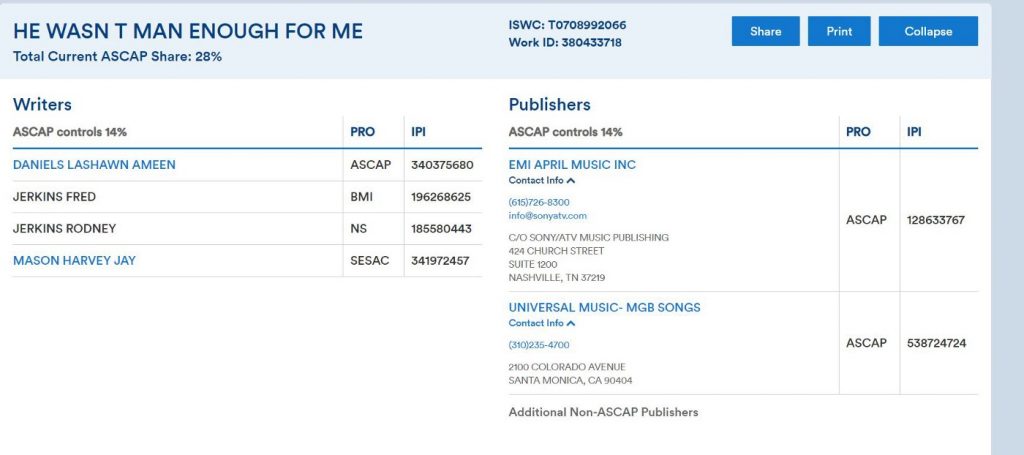
This search happens to be fruitful, identifying ASCAP’s 28% share of the song. Also, the search reinforces all of the appropriate songwriters and producers listed on the track. Rodney Jerkins is professionally known as “Darkchild” on the production side.
You can do the same search over at BMI to find additional repertory information.
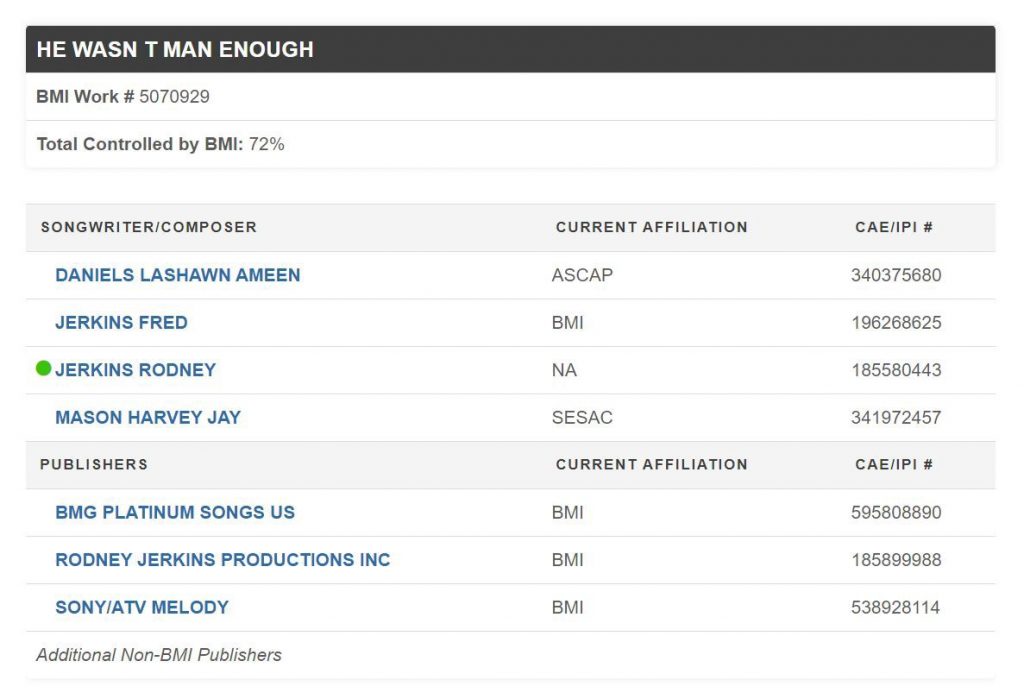
BMI appears to control the other 72%.
The next step would be to contact all of the publishers to agree to terms, including a clearance fee and normally a piece of the publishing for the new work. Dealing with BMG, Sony/ATV, and Universal in this scenario makes this clearance process a bit easier than normal. Sometimes a songwriter or producer is not up to date with their publishing and might not even be registered for a PRO or be around to contact. These situations can get very tricky if songs are not registered correctly or a songwriter/producer is self-published and is missing or unfortunately deceased.
Throughout the process of clearing a sample, keep in mind the costs associated with the process. More than likely, you will be hiring an attorney to spearhead the process, but it is very important to understand the process yourself to either assist or possibly even take on the mission of clearing a sample on your own.
How Much Does It Cost to Clear a Sample?
There is no flat price for clearing a sample. The cost depends on the song being sampled, how recognizable the sample is, how much leverage each side has, how the new song will be released, and how much ownership the original rights holders want in the new work.
On the master side, the clearance fee will likely range somewhere between $2,000 to $10,000. Additionally, the owner of the master will likely require some sort of split on the new master in the 3% to 10% royalty range. Remember, if you have less money to offer, be flexible in regards to giving up a share of the royalty. These terms are freely negotiable.
On the publishing side, the clearance fee should be negotiated “all-in,” meaning whatever fund you have for that side is distributed pro-rata to all the owners of the composition. The fee will again likely range somewhere between $2,000 to $10,000. Most composition rights holders will agree to this scenario, but I have seen crazier things. When clearing the publishing side, you will also more than likely have to give up a share of publishing to the composition’s rights holders. The publishing royalty in the new work should be no more than 50% all-in distributed pro-rata. Again, if you have less money for the clearance fee, you might be inclined to offer more publishing as a compromise.
Important note: These numbers are examples, not guarantees. Sample clearance terms can change depending on the rights holders, the use, the artist’s leverage, and the projected value of the release.
Sharpen your skills…
Types of Legal Contracts for Music Producers
Copyright Crash Course with Cosynd and Symphonic
Music Publishing Explained: Royalties, Rights & Who Gets Paid
Sample Clearance Examples
The art of sampling is a music pastime, especially in the hip hop genre, but the key is to try to clear a song’s sample before it takes off. There are countless horror stories where artists have sampled a song but didn’t get the proper clearance, and by the time the rightful copyright holders became aware of the sample, it was too late.
In 2012, Baauer dropped the EDM smash “Harlem Shake.” Huge record nonetheless, remember? The multi-platinum song peaked at number one on the Billboard Hot 100 in the U.S., New Zealand, Australia, and Brazil.
Problem is, the song contained unlicensed samples from Plastic Little and reggaeton artist Hector Delgado. Baauer told Daily Beast that he found the recording of Delgado online: “the dude at the beginning I got off the Internet, I don’t even know where.” MTV News
In 2013, a year later, Pitchfork asked him:
Pitchfork: “Have you made a lot of money from it?”
Baauer: “I still don’t know. I haven’t seen any money from it.”
Before that one, Lord Tariq and Peter Gunz sampled Steely Dan’s “Black Cow” for their huge hit “Deja Vu (Uptown Baby)” in 1997. In exchange for clearing the sample, Steely Dan requested an advance payment of $115,000 as well as 100% of publishing royalties.
“Deja Vu (Uptown Baby)” ended up at number nine on the Billboard Hot 100, went multi-platinum, and was a radio smash. Steely Dan members Walter Becker and Donald Fagen are the sole credited songwriters on “Deja Vu (Uptown Baby),” not the actual lyricists.
In both cases, the sample was probably worth it because it created touring and merchandise opportunities as well as the notoriety associated with the smash hit, but man, I’m not sure any sample is worth 100% of publishing.
More recently, the late and great Juice WRLD interpolated Sting’s “Shape of My Heart.” While there was not a lawsuit, things were reportedly negotiated after the fact, and Juice WRLD’s producer Nick Mira tweeted that Sting, whose track “Shape of My Heart” is interpolated on the record, took 85% of the publishing.
Sample vs. Interpolation: What’s the Difference?
Do not use sample and interpolation interchangeably. A sample is literally taking a piece of the master recording and putting it in your new work. An interpolation is replaying or recreating a piece of music to sound like the old song without using the original recording.
A sample usually requires clearance for both the master and the composition. An interpolation usually requires clearance for the composition only because the original sound recording is not being used.
Songtrust explains it this way: a sample uses a snippet of an original song in a new work, while an interpolation recreates the recording note for note and reflects the underlying composition. You can learn more about the difference between a sample and an interpolation in their breakdown.
Sample Clearance Checklist for Artists
Before releasing a song with a sample, make sure you can answer these questions:
- What song or recording did you sample?
- How much of the original recording did you use?
- Where does the sample appear in your new song?
- Who owns or controls the master recording?
- Who owns or controls the composition?
- Have all master and publishing rights holders approved the use?
- Are the clearance fee, royalty split, publishing split, and credit terms written down?
- Does the agreement cover your planned release, including streaming, downloads, video, sync, social media, and future uses?
If you cannot answer these questions yet, the safest move is to pause the release until the rights are clear.
In Conclusion…
The art of sampling is a music pastime, especially in hip hop, but the key is to try to clear a song’s sample before it takes off. Samples can be a new revenue stream for original artists, songwriters, and producers too, so it is usually in everyone’s benefit to work things out.
Still, artists need to understand what they are giving up. A great sample can make a song feel undeniable, but it can also affect your royalties, publishing, release timeline, and long-term ownership. Before you build a release around a sample, make sure the creative upside is worth the business tradeoff.
Remember These Keys To Clearing A Sample:
- Identify who owns or controls the master recording, usually a performer, label, or catalog owner.
- Identify who owns or controls the publishing, usually a publisher, songwriter, producer, administrator, or estate.
- Try to clear the sample before you announce a major label deal.
- Try to clear the sample before you release the song.
- Negotiate “all-in” clearance fees if possible.
- Remember you still have leverage. Samples are new revenue streams for old copyright owners.
- Get the final agreement in writing before the song goes live.
For artists and labels looking to protect their catalog, manage royalties, and better understand how rights flow across releases, Symphonic’s Rights Management services can help support the bigger picture.
Want to learn more? To expand your mind, check out some of Karl’s other great articles here.
Sample Clearance FAQ
Do I need permission to use a sample?
Yes. If you use part of an existing sound recording in your song, you typically need permission from both the master recording owner and the composition owner before release.
What rights do I need to clear a sample?
You usually need a master use license for the sound recording and a license for the underlying composition, which may involve songwriters, publishers, publishing administrators, or estates.
How much does it cost to clear a sample?
Costs vary widely. Artists may face upfront fees, royalty shares, publishing splits, or a combination of all three, depending on the rights holders and leverage on both sides.
Is interpolation the same as sampling?
No. A sample uses the original recording. An interpolation recreates part of the original composition without using the original audio, which usually means the master recording does not need to be cleared.
Can I release a song with a sample before it is cleared?
Artists should avoid releasing music with uncleared samples. Clearance should be handled before release to reduce the risk of takedowns, frozen royalties, delayed distribution, or legal issues.
Can a small sample still cause copyright issues?
Yes. Even a short sample can create issues if it uses protected parts of a master recording or composition without permission. The safest approach is to clear the sample before release.

Other Stories You May Like