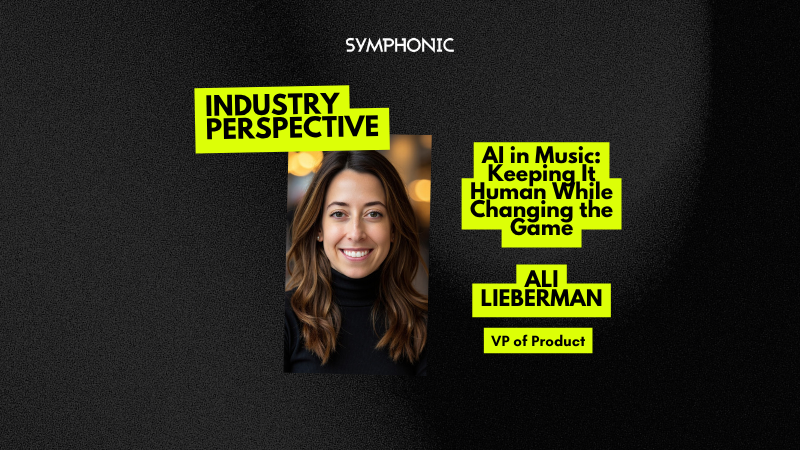
AI is everywhere right now, but not every new tool is actually solving a real problem. As the industry rushes to adopt automation, the real question becomes: what’s genuinely useful, and what’s just noise? Drawing from over a decade of experience building music industry infrastructure, Ali Lieberman, Symphonic’s VP of Product, breaks down where AI is delivering real value and where it’s falling short.
Ali has played a key role in developing tools and systems that support artists, labels, and publishers at scale. With experience at SoundExchange, the RIAA, and now Symphonic, she brings a product-focused perspective on how AI can streamline workflows, reduce friction, and actually improve how the industry operates.
Below, she shares how to think about AI beyond the hype and what it really means for artists, teams, and companies navigating this next phase of music tech…
Let’s Talk About The Future of AI Music
By Ali Lieberman, VP of Product at Symphonic

Consider This Prompt: You are one of the greatest songwriters of all time. Your longtime girlfriend and bandmate unexpectedly writes and records a mystical, ethereal banger about breaking up with you… Joke’s on her, though. You decide to craft a sharp, clever, and emotionally charged rebuttal song from your perspective. The song should respond directly to her lyrics while capturing your feelings of frustration and irony. And it needs to be a hit…
Let’s be real, no AI model is going to output Fleetwood Mac. (Well, maybe GPT-5..). But I am optimistic it’s going to revolutionize the way our industry runs in a big way, removing the biggest barriers people face while making music and helping move the industry forward.
Every week, there’s another press release: “Undetectable AI-powered mastering!” “Agentic AI marketing campaigns are here!” “We can detect all AI-generated music!” Like a great breakup track, these tools make big promises. Some are legitimately game-changing, but there are plenty of solutions out there just looking for a problem to solve. They’re impressive on paper, but not necessarily designed for who’s actually using them.
Making AI Work for You
For AI and automation to truly deliver value, they need to feel like your super assistant and thought partner. It should be a teammate who takes care of the grunt work so you can focus on what you do best: creating, connecting, and growing.
The best AI-powered music tech makes the hard stuff invisible. It can enable seamless release uploads and metadata entry using an AI agent. It can create tailored marketing strategies using the latest model. It can analyze emerging music trends on social media platforms to inform your next move. These needs are foundational, but the AI solutions can appear challenging to adopt and change drastically every week.
Think about an indie artist releasing their first EP. They don’t want to decipher complicated metadata forms or style guide specs. They want to create and be able to trust that the system will support them without causing headaches. AI can lower those barriers to entry.
Beyond the Artist
Labels and larger organizations in the industry are constantly juggling millions of releases, rights, and revenue streams. AI can automate data reconciliation and error detection, reducing costly manual work while enabling teams to focus on strategy and artist development. In addition, major companies can benefit from AI-driven predictive analytics to streamline underwriting for advances or build simplified systems to manage the ever-evolving copyright ownership landscape. It can even provide insights into how to best deploy capital.
But none of these gains matter if the tools are confusing or opaque to the people making the decisions, pressing the buttons, and having the critical conversations. The real breakthroughs in music tech won’t come from the next shiny AI feature. They’ll come from companies, teams, and individuals asking the right questions upfront:
- What unique advantage do we have, and how can we maximize it using AI?
- What goal will this AI solution help us achieve?
- How will AI adoption reshape our team? What new skills will we need, and what existing roles can now shift toward higher-value work?
From those questions, companies can work backward to create tools that solve real problems and not just chase buzzwords.
Looking Ahead…
Music is still a deeply human business. Songs tell stories. Artists build relationships. Teams collaborate across time zones and genres. Companies build the systems to integrate it all. But no matter how smart AI gets, it can’t replace the nuance, emotion, or creativity that fuels our industry…
But it can certainly help.
—
Key Takeaways
- AI is most valuable when it removes friction, not when it adds complexity or unnecessary features.
- The best tools act as assistants, handling tedious tasks so artists and teams can focus on creative and strategic work.
- Not every AI solution solves a real problem, so it’s critical to evaluate tools based on actual use cases, not hype.
- For artists, AI can lower barriers to entry by simplifying processes like metadata, distribution, and marketing.
- For labels and companies, AI’s biggest impact lies in automation, data analysis, and scaling operations more efficiently.
- Even as AI evolves, the music industry will continue to rely on human creativity, relationships, and decision-making.
Other Stories You May Like