


There’s a shift happening in the music industry. As AI continues to accelerate how music is created, distributed, and licensed, the value of authenticity is becoming more important than ever. In a landscape where content can be generated instantly, what actually stands out isn’t speed, it’s human connection.
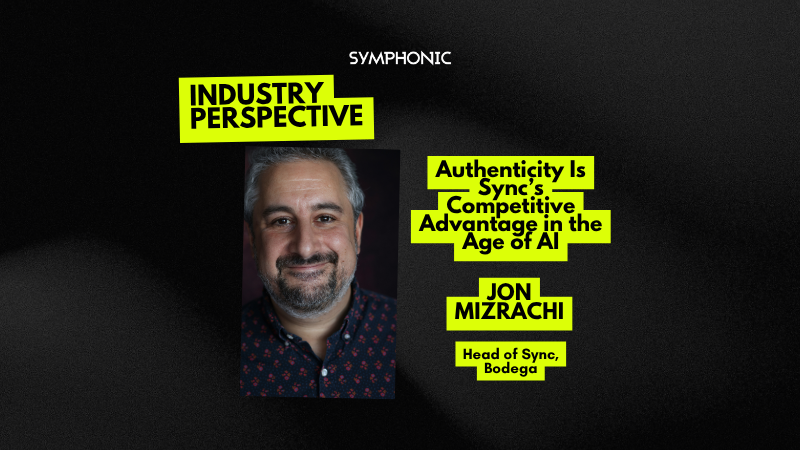
Drawing from years of experience in sync licensing and real-world placement strategy, Jon Mizrachi, Symphonic’s Head of Sync and the force behind Bodega Sync, breaks down why authenticity is becoming a competitive advantage in the age of AI. 🤖
Jon plays a key role in helping independent artists secure placements across film, TV, and brand campaigns. With deep experience working directly with music supervisors, agencies, and creative teams, he brings a clear perspective on what actually gets selected and why.
Below, he shares how this shift is playing out in sync and what it means for artists looking to stay competitive in a rapidly changing landscape…
Authenticity Is Sync’s Competitive Advantage in the Age of AI
By Jon Mizrachi, VP, Head of Sync at Symphonic & Bodega Sync
The Shift AI Is Creating in Music

The speed at which AI is advancing is a legitimate cause for concern across many fields, displacing work that could previously only be done by humans. We’re currently in a transitional period where existing workers can use AI to achieve the highest productivity and efficiency, but this shift will inevitably lead to fewer job opportunities for those seeking work.
Not only that, but it brings about this feeling that we may just be training our digital replacements. This is a universal consequence of technology, but for the first time, it’s not just tedious work that’s being eliminated…
It’s art.
We live in a world where technology affords artists the ability to quickly create songs and have them in the ears of their fans within a matter of days, or even hours. AI offers the possibility that the entire music production process could be reduced to nothing more than a prompt. The amount of music being released into the marketplace today is exponentially higher than in past decades, but the overall quality has not increased proportionally to the output.
Since quality, cost, and time are all tied to each other, turning up the speed at which music is created reduces the value.
The Tradeoff Between Speed and Value
One place where this tradeoff will be welcomed is production music, which has actually increased in quality over the years despite the need to remain cost-competitive relative to licensing artist material.
For some music libraries, competing in this space is simply a race to the bottom. The production music sector is likely to be dominated by AI-generated music in the coming years, but there’s a trend running counter to this in the sync licensing world.
Authenticity.
Why AI Falls Short in Emotional Storytelling
Just because technology can instantly spit out a song doesn’t mean it will be any good.
It’s all just well-crafted collage work made from previously existing ideas. Sticking an AI-generated instrumental EDM track in the background of a club scene might go unnoticed, but it’s unlikely that an emotional featured montage is going to use a song by an AI singer-songwriter.
The difference is the humanity of the person who wrote the song, their full emotion, and collected lived experience subtly communicated through their creative choices. The thing that gets you misty is the break in a singer’s voice that communicates vulnerability, or a big belt at the peak of the song.
If you’re telling an immigrant story, the soundtrack needs to reflect the authentic sound of that culture. AI-generated soundalikes won’t cut it. We all want to feel connected and feel the emotions in the stories being told on the screen. Human artists have a monopoly on that, at least for the foreseeable future.
Sure, it can be imitated, but the special sauce that makes their music compelling and adds depth is not just what they sound like, but who they are.
What This Means for Artists
As the world moves in the direction of AI-generated content, what will stand out are creators who fill their art with their own humanity. Their music is what will resonate with other creators seeking songs that help tell authentic stories. It’s more important than ever to make sure your music is less about imitating your influences and more about defining who you are as an individual.
It will pay dividends over time.
—
Key Takeaways
- Authenticity is becoming more valuable as AI increases the volume of music being created.
- Faster production doesn’t always mean better music, and can actually reduce perceived value.
- AI may dominate functional or background music, but human emotion still drives impactful sync placements.
- Cultural and personal identity play a major role in how music connects within visual storytelling.
- Artists who lean into their own perspective will stand out more as AI-generated content becomes more common.
Other Stories You May Like

Symphonic Partners with Ringtones.com
